The Complete Guide to Answer Engine Optimization (AEO)
What is Answer Engine Optimization (AEO) ?
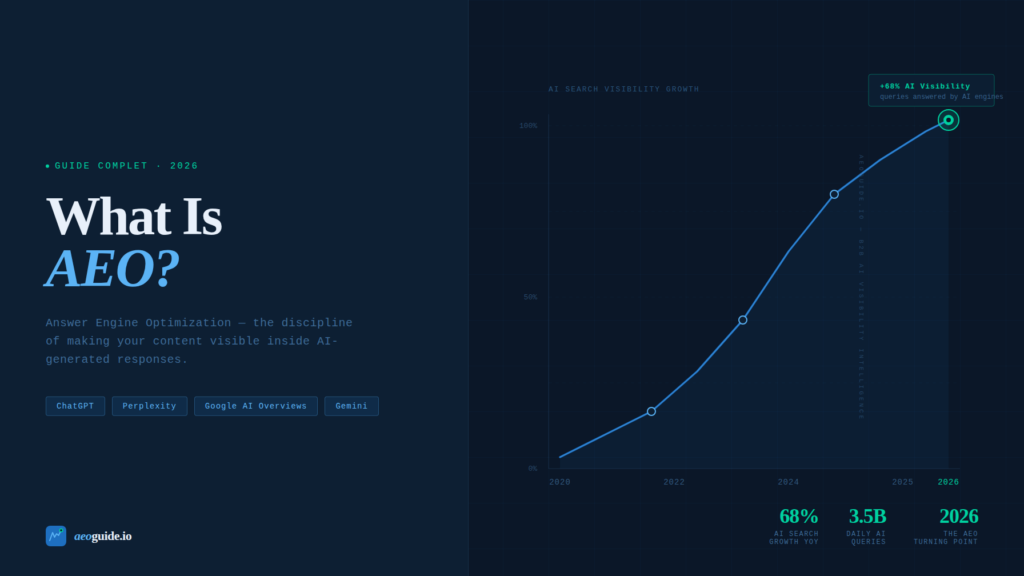
Answer Engine Optimization is the process of structuring, formatting, and positioning your content so that AI answer engines — including ChatGPT, Perplexity AI, Google AI Overviews, Gemini, and Claude — select it as a source when generating responses to user queries.
Unlike traditional SEO, which aims to rank your pages in a list of results that users then click on, AEO aims to make your content the substance of the answer itself. Your brand is cited. Your data is quoted. Your perspective shapes what the AI tells the user — before the user ever visits your site.
What is Generative Engine Optimization (GEO) ?
Generative Engine Optimization (GEO) is an emerging digital strategy focused on optimizing content for AI-powered generative engines such as ChatGPT, Google Gemini, and other large language models. If you’re wondering what is GEO, it refers to the process of crafting content that is easily understood, trusted, and reused by AI systems when generating answers to user queries. The GEO meaning goes beyond traditional SEO by targeting how AI selects, synthesizes, and cites information in real time. A strong GEO strategy emphasizes high-quality, authoritative content, semantic clarity, structured information, and strong topical relevance to increase the chances of being included in AI-generated responses. This generative engine optimization guide approach ensures your brand becomes a reliable source that AI models reference when delivering answers. In short, the GEO definition is about optimizing for AI comprehension, contextual relevance, and credibility, positioning your content at the core of the new AI-driven search ecosystem.
What difference between AEO vs SEO vs GEO ?
The difference between SEO, AEO, and GEO comes down to how content is discovered, selected, and delivered to users in today’s search ecosystem.
SEO (Search Engine Optimization) is the traditional approach. It focuses on optimizing your website to rank higher on search engine results pages (SERPs) like Google. The goal is to drive clicks through keywords, backlinks, technical performance, and content relevance. With SEO, users still browse multiple links to find their answer.
AEO (Answer Engine Optimization) is more targeted. It aims to make your content the direct answer to a specific query. If you’re asking what is AEO, it’s about structuring content (FAQs, concise definitions, schema markup) so search engines and voice assistants can instantly extract and display it. The goal is zero-click visibility—your content is the answer itself.
GEO (Generative Engine Optimization) is the newest evolution. It focuses on optimizing content for AI-generated responses from tools like ChatGPT or Google Gemini. Instead of ranking or being quoted directly, your content is understood, synthesized, and reused by AI models. The goal is to become a trusted source within AI-generated answers.
AEO vs SEO: What Changed and What Did Not
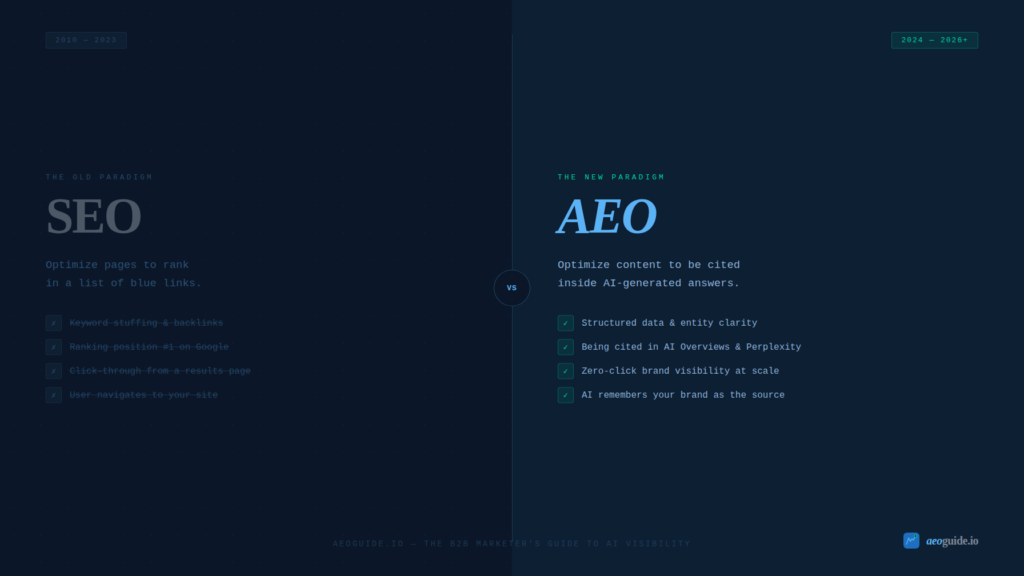
The most common misconception about AEO is that it replaces SEO. It does not. SEO remains foundational — without crawlable, indexed, technically sound content, AI engines cannot surface your material in the first place. AEO adds an optimization layer on top of that foundation, designed for how AI systems select and synthesize information.
|
Dimension |
SEO |
AEO |
|
Primary goal |
Rank in search engine results pages |
Be cited inside AI-generated answers |
|
Optimization target |
Algorithms (crawl, index, rank) |
AI language models (understand, cite, trust) |
|
Success metric |
Keyword ranking & organic traffic |
Citation frequency & AI visibility share |
|
Content format |
Long-form blog posts, landing pages |
Direct answers, structured data, entities |
|
Visibility type |
Click-based (user visits your site) |
Zero-click (brand cited without a click) |
|
Key signals |
Backlinks, page speed, E-E-A-T |
Schema markup, entity authority, credibility |
|
Tools |
Semrush, Ahrefs, Screaming Frog |
AEO-native tools (see our pillar page) |
|
Status in 2026 |
Still relevant — foundational layer |
Rising priority — the new differentiation layer |
The practical implication for B2B marketing teams: your existing SEO investment is not wasted, but it is no longer sufficient. A page that ranks #3 in Google organic results may still be invisible in AI-generated answers if it is not structured in a way that language models can extract, parse, and trust.
Why 2026 is important for Answer Engine Optimization ?
AEO has fundamentally changed in 2026 due to the rapid evolution of AI-powered search and user behavior. Previously, AEO focused mainly on optimizing content for featured snippets and voice search. Today, the landscape is driven by advanced answer engines like ChatGPT, Google Gemini, and AI Overviews, which prioritize contextual understanding, real-time synthesis, and trusted sources over simple keyword matching. This shift has redefined the AEO meaning: it’s no longer just about providing a short, direct answer, but about delivering highly reliable, structured, and AI-friendly content that can be selected, combined, and explained by intelligent systems.
One of the biggest changes is the importance of semantic depth and authority. In 2026, answer engines evaluate content based on expertise, clarity, and relevance within a broader topic—not just a single query like what is AEO. Structured data, entity optimization, and clear question-answer formats remain essential, but they must now be supported by comprehensive, trustworthy content ecosystems. This new answer engine optimization guide approach means brands must think beyond rankings and focus on becoming credible knowledge sources. In short, AEO in 2026 has evolved from optimizing answers to optimizing for AI understanding and trust, making it a critical pillar of modern digital visibility.
Core AEO Optimization Principles
The following principles form the foundation of any AEO strategy. These are not speculative tactics — they are documented practices that improve citation probability across the major AI engines.
5.1 Answer-first content structure
AI engines favor content that answers the question in the first paragraph, then supports and expands on the answer. This is the inverse of traditional SEO content that builds toward a conclusion. For AEO, lead with the answer. Use the rest of the content to substantiate it.
5.2 Entity optimization
AI language models think in entities — named concepts, brands, products, people, locations, and relationships between them. Content that clearly defines what an entity is, what it does, and how it relates to adjacent concepts builds what researchers call ‘entity authority.’ This is distinct from domain authority in the traditional SEO sense.
5.3 Structured data and schema markup
Schema markup (particularly FAQPage, HowTo, Article, and Product schemas) signals structure to both traditional search engines and AI crawlers. FAQPage schema in particular has a strong correlation with AI Overview citations.
- All Posts
- AEO Fundamentals
Which AEO tracking tool should you choose in 2026? Otterly AI is the most accessible entry point at $29/month with...
Learn how to track your AI visibility for free with proven methods. Monitor your brand presence on Perplexity, ChatGPT &...
Learn how to optimize your B2B content for Google AI Overviews with proven technical strategies that increase visibility and drive...
AEO vs SEO: discover the key differences, why B2B marketers must adapt their strategy in 2026, and how to rank...
Struggling to prove AEO ROI to your B2B stakeholders? Discover the metrics that actually matter and how to track them...
AEO Content Checklist: 15 Points to Optimize Any Page for AI Engines What is an AEO content checklist? An AEO...
Frequently Asked Questions About AEO
Is AEO replacing SEO?
No, AEO complements SEO rather than replacing it. You still need strong technical SEO and quality content as a foundation. AEO adds a layer optimized for how AI engines select, synthesize, and cite information. Think of SEO as the ground floor and AEO as the floor you’re now building on top.
Do I need a technical background to implement AEO?
Not necessarily. Core AEO practices, writing clear definitions, structuring content around questions, using schema markup — can be implemented by any marketer with basic WordPress knowledge. More advanced tactics (entity optimization, vector similarity) may benefit from technical support.
Which AI engines should I optimize for?
In 2026, prioritize Google AI Overviews (largest reach for B2B), Perplexity AI (fastest-growing research engine), and ChatGPT with browsing (high intent queries). Gemini is gaining ground especially in Google Workspace contexts relevant to B2B buyers.
How long before I see AEO results?
Citation tracking tools can show early signals within 4–8 weeks of implementing structured content. Meaningful visibility shifts typically appear over 3–6 months, similar to content SEO timelines. AEO is a long-term investment, not a quick-win tactic.
Does AEO work for B2B specifically?
Yes, arguably better than for B2C. B2B buyers increasingly use AI tools to research vendors, compare solutions, and generate shortlists. Being the brand an AI cites when a buyer asks ‘what is the best solution category for a defined use case has enormous commercial value.
Can small B2B companies compete with large brands on AEO?
More easily than in traditional SEO. AI engines prioritize content clarity, entity authority, and answer specificity over domain authority alone. A smaller brand with highly structured, direct, credible content on a niche topic can outperform a large brand with generic content — which is a significant opportunity for focused B2B players.